

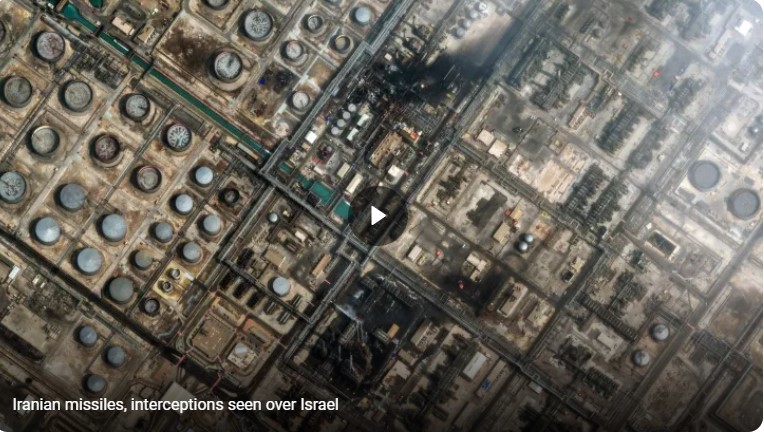
The Middle East is facing a sharp escalation after a series of coordinated attacks by the United States and Israel against Iran triggered retaliatory strikes and widening violence across the region.
In Iran, key government and symbolic sites in Tehran have been struck, including the state broadcaster and a UNESCO World Heritage landmark, while the death toll has topped 700 people, including Supreme Leader Ayatollah Ali Khamenei. Washington has warned that “harder hits” are still to come, as Tehran escalates retaliatory attacks by closing the Strait of Hormuz and launching attacks on US and allied targets across the region, including attacks on energy facilities.
Here’s where things stand.
In Iran
- Key sites damaged in Tehran: Recent strikes in the capital have hit the Islamic Republic of Iran Broadcasting (IRIB) complex. The strikes have also damaged the historic Golestan Palace, a UNESCO World Heritage Site.
- Further escalation expected: US Secretary of State Marco Rubio has warned that the “hardest hits” on Iran are “yet to come”.
- Ongoing military actions: Trump stated that attacks on Iran will persist until all US objectives are met.
- US and Israeli justifications: US Defense Secretary Pete Hegseth defended the strikes, stating they are designed to cripple Iran’s navy and end its nuclear and missile ambitions.
- Strait of Hormuz: Iran’s Revolutionary Guard Corps have declared the Strait of Hormuz closed, threatening to set fire to any vessel attempting to pass.
- Death toll: At least 787 people have been killed in Iran, notably including Supreme Leader Khamenei, state media said citing the Iranian Red Crescent. Additionally, Iranian state media reported that a US-Israeli strike hit a girls’ school in southern Iran, killing at least 165 people.
In Gulf nations
- Qatar: The Gulf country has faced direct military spillover, intercepting dozens of Iranian ballistic missiles and drones.
- While most were stopped, two missiles struck the Al Udeid Air Base, which houses US forces, and a drone hit an early warning system. Additionally, Qatar’s air force shot down two Iranian jets that were heading towards the country, and multiple explosions have been heard in the skies over Doha.
- On Monday, QatarEnergy, the world’s largest producer of LNG, said it had halted production after Iranian attacks.
- Kuwait: Three US fighter jets crashed in Kuwait. The US military claimed the jets were “mistakenly” shot down. Videos that emerged on Monday showed a US F-15E Strike Eagle fighter jet spinning and spiralling downwards with its tail on fire and smoke trailing behind it. Kuwait’s foreign ministry on Tuesday condemned the targeting of the US Embassy by Iran. Earlier, the US embassy announced that “it will be closed until further notice”, citing ongoing region tensions.
- Saudi Arabia intercepted eight drones near Riyadh and Al-Kharj. Additionally, the US Embassy in Riyadh was hit by at least two drone attacks, causing a limited fire. The US Embassy is closed on Tuesday, and all routine and emergency services have been cancelled.
- Widespread US evacuations: The US Department of State has urged its citizens to immediately depart several Gulf nations, including Bahrain, Kuwait, Oman, Qatar, Saudi Arabia, and the UAE, via commercial means due to the escalating violence.
- Ongoing threats to US assets: More broadly, Tehran is continuously carrying out raids against US military and strategic assets located throughout the Gulf region.
- UAE resumes limited flights: Dubai’s airport authority said on Monday that it had authorised a “small number” of flights to operate from Dubai International Airport, the world’s busiest gateway for international passengers, and Dubai World Central airport.
In Israel:
- Defending against Iranian retaliation: The Israeli military has confirmed that it has identified incoming missiles launched from Iran. Israeli air defence systems are actively operating to intercept these strikes.
- Israel successfully intercepted two drones launched from Lebanon. Hezbollah has defended its own recent missile attacks on Israel as a legitimate response to 15 months of “Israeli aggression” and a violation of a 2024 ceasefire agreement.
- Netanyahu defends military action in Iran: Prime Minister Benjamin Netanyahu defended the strikes on Iran’s nuclear sites, asserting that Iran’s new underground bunkers would have become “immune within months”. He also told Fox News that “this is going to be a quick and decisive action” and “it’s up to the people of Iran in the final count to change the government.”
