

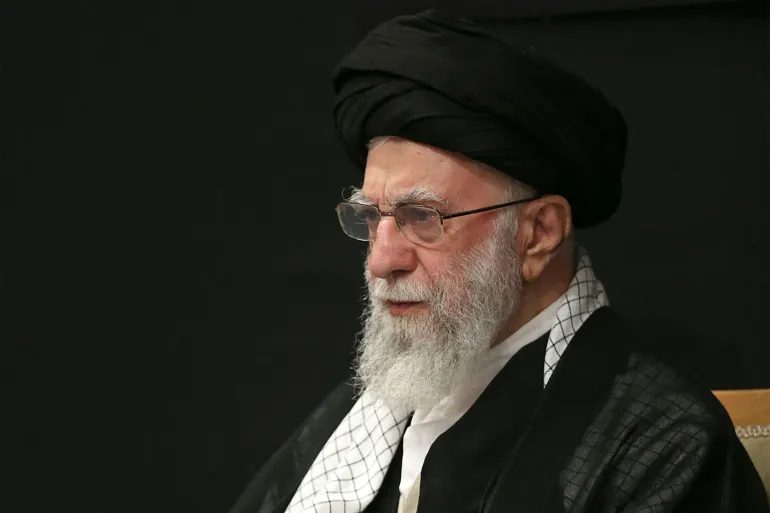
After more than three decades as Iran’s supreme leader, Ayatollah Ali Khamenei, was assassinated in US and Israeli air strikes on Saturday morning.
The man who led the country in two capacities since 1981 was a key figure in the Islamic revolution that overthrew the Iranian monarchy in 1979. He first served as president, then as supreme leader following the 1989 death of revolutionary leader Rohollah Khomeini.
While credited with leading Tehran through a bloody, eight-year war against Iraq in the 1980s and fostering an economy that survived despite Western sanctions, his reign was racked by mass protests against rigged elections, human rights violations and economic hardship.
Most recently, protests in December and January, which escalated from demonstrations by shopkeepers in Tehran over inflation to calls for regime change across the country, were violently suppressed by state forces, resulting in massacres.
Khamenei was killed early in the strikes, along with several senior military officials, including from the elite army unit, the Iranian Revolutionary Guard Corps (IRGC).
As of Monday, 787 people had been confirmed killed across the country, according to the Iranian Red Crescent. At least 165 schoolgirls and staff were killed in a strike on a school in southern Minab city on Saturday.
Here’s what we know so far about how Khamenei’s assassination unfolded:
Khamenei was killed in a central Tehran location that houses the offices and residence of the supreme leader, Iran’s president, and the country’s National Security Council.
According to The New York Times, which cited anonymous sources familiar with the operation, the US’s Central Intelligence Agency (CIA) had gathered information about a Saturday morning meeting there that would include Khamenei and the country’s senior military cadre. The CIA then shared the information with Israel.
CBS, also citing an anonymous official, reported that the CIA shared Khamenei’s location data with Israel.
In US President Donald Trump’s Truth Social statement in the wake of Khamenei’s killing, he wrote that the late leader “was unable to avoid our Intelligence and Highly Sophisticated Tracking Systems and, working closely with Israel, there was not a thing he, or the other leaders that have been killed along with him, could do”.
It is unclear if the US intercepted phone or other digital communications, used satellite imagery, or used covert human agents to obtain this information.
It is also unclear why the country’s most senior military leaders decided to gather in a predictable location while threats of a US-Israel attack were imminent.
It is known, however, that Israel has long recruited covert operatives in Iran and was watching Khamenei’s circle for years, gathering information as mundane as how and where they get food, an unnamed ex-CIA official told The Guardian. During the 12-day war last June, six Iranian nuclear scientists were assassinated, some in their homes.
Analyst Rosemary Kelanic, speaking to Canadian public broadcaster CBC, said the US probably used a “combination of human intelligence on the ground, potentially through Israeli assets, as well as signals intelligence and the ability of the United States to use over-the-horizon and, in this case, local assets to target pretty much anywhere on the planet that it wants to hit”.
The CIA had also been tracking Khamenei’s location for months, according to The Times, even before the 12-day war. Since that conflict, the US had intensified its surveillance of Khamenei, as well as of the IRGC, in general, monitoring how officials communicated and moved during stress periods, the Times reported.
Trump had also referred to US intelligence regarding the supreme leader’s location last year.
